
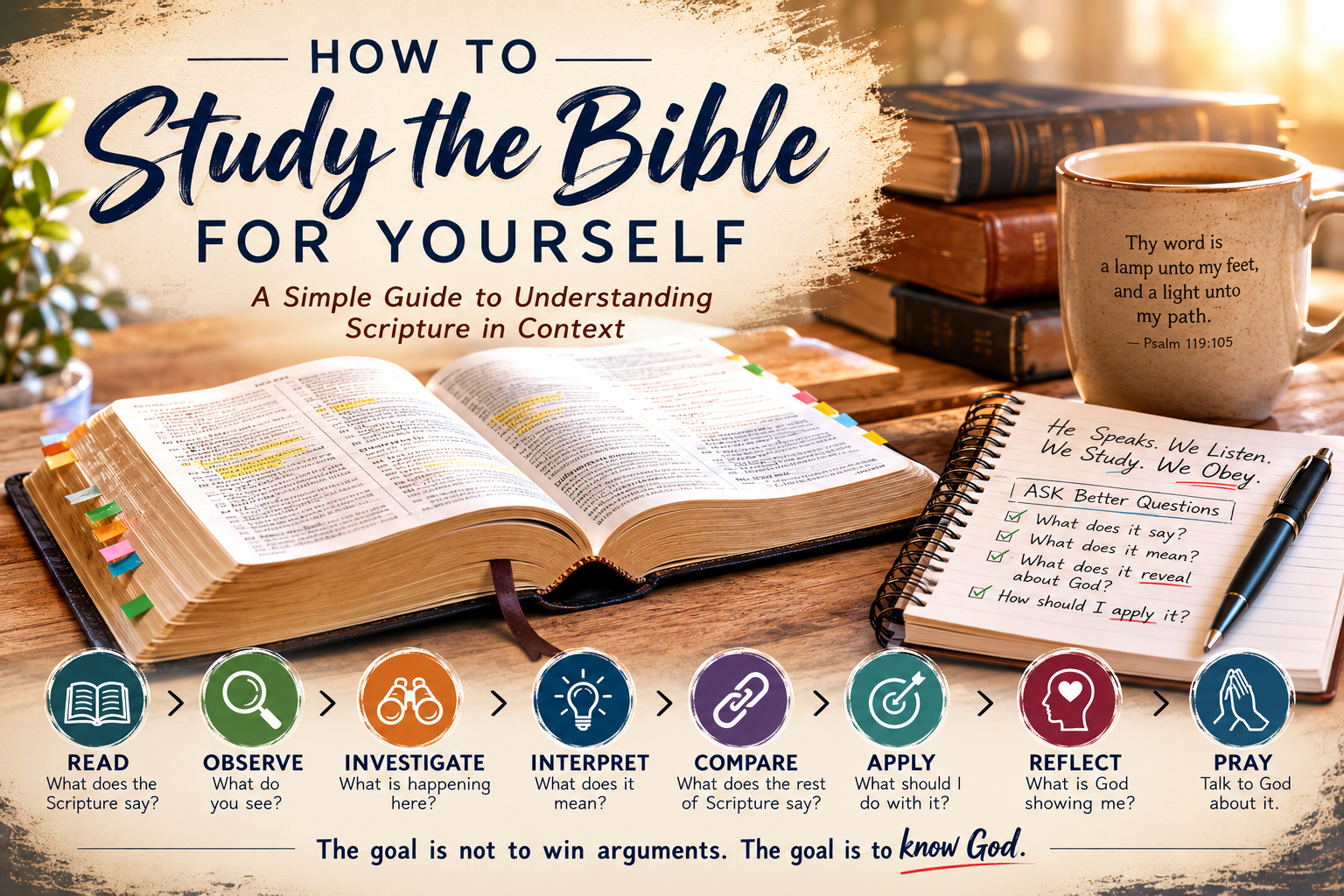
A Simple Guide to Understanding Scripture in Context
Relationships require familiarity. Think about the relationships in your life. You know the person or are actively getting to know them. You listen to them, ask questions, talk to them, and you want to know about the things that matter to them.
It’s the same process when you are establishing a relationship with Jesus.
You want to know Him, so you listen to Him by reading His Word. You ask questions by studying Scripture. You talk to Him in prayer, and you search the Scriptures to find out what really matters to Him.
The result: You come to know His voice. You learn how to walk as He walked. His values become yours. You begin to reflect His character and nature as He writes His Word on your heart.
You fall in love with Him and embark on a relationship that transforms you and takes you on a journey of ongoing discovery as you explore the many layers of His Word.
This does not require a seminary degree or pastoral ordination. You don’t have to be a Bible scholar to study the Bible well.
You just need a heart for God and a desire to know Him — really know Him.
This means you must be willing to view Scripture through a clean lens, not through what you’ve heard, the traditions you hold close to you, or what you’ve been taught.
Slow down. Pay attention. Ask questions. And be willing to reconsider things you thought you already knew.
Many of us learned the Bible through sermons, Sunday school lessons, Bible studies, books, family traditions, or statements we heard repeated so often that they became part of what we believe. Some of those things can be helpful. Good teachers are a gift.
But some of those sayings we’ve all repeated at some point aren’t even in the Bible. Many sincere Christians who love God are shocked when they discover that.
“Study to shew thyself approved unto God, a workman that needeth not to be ashamed, rightly dividing the word of truth.”
— 2 Timothy 2:15
We are commanded to study Scripture, not passively read it. Study. There’s a difference.
God wants us to dig into His Word and explore it — questioning, investigating, and solidifying our own understanding because what we understand affects how we walk with Him.
Scripture tells us to “work out [our] own salvation with fear and trembling” (Philippians 2:12).
Your parents can’t do that for you. Your grandparents can’t. Your pastor can’t.
You have to know what you believe and why you believe it.
There is a difference between knowing what you have been taught about a verse and knowing what the verse actually says.
That is why one of the most important principles of Bible study is simple:
Start with the text, not the conclusion.
Instead of beginning with, “How can I prove what I believe?” begin with:
“What does Scripture actually say?”
Then be willing to follow the answer wherever it leads.
The Holy Spirit Is Essential to Understanding Scripture
There is something even more fundamental than having the right Bible study method.
You need the Holy Spirit.
God did not give us His Spirit merely so that we could have a spiritual experience. He didn’t do it so we could clap our hands, dance around, and get our Holy Ghost for the week.
He gave us His Spirit to be our Comforter, to empower us for spiritual warfare, and to help us understand the things of God.
Jesus told His disciples:
“But the Comforter, which is the Holy Ghost… he shall teach you all things…”
— John 14:26
Paul explains in 1 Corinthians 2 that God reveals the things of God to us by His Spirit and that spiritual things are spiritually discerned.
Human intellect alone cannot produce spiritual understanding.
You can research Greek and Hebrew words. You can study history and culture. You can compare translations, read commentaries, and become very knowledgeable about the Bible.
Those things can help you study.
They cannot replace the Holy Spirit.
And there is a difference between simply having received the baptism of the Holy Ghost and living submitted to the Holy Ghost.
If you have not received the baptism of the Holy Ghost, seek God for it.
If you have received the Holy Ghost, submit to Him.
Let Him correct you. Listen when He draws your attention to something in God’s Word. Follow when Scripture takes you somewhere you did not expect. Ask Him for revelation and understanding, and then study diligently.
The Holy Spirit and careful Bible study are not competitors.
God teaches us through the Word He inspired – and He does it through His Spirit.
Begin With Prayer and a Sincere Desire to Know God
Bible study is more than an intellectual exercise. We are studying the Word of God.
Before you begin, pray.
Prepare yourself to receive His Word.
Begin with repentance and forgive anyone who has offended or sinned against you. Clear away the things that can harden your heart so His Word can permeate it and sink into your spirit.
Next, pray Psalm 139:23–24:
“Search me, O God, and know my heart: try me, and know my thoughts:
And see if there be any wicked way in me, and lead me in the way everlasting.”
Ask God to plow your heart and prepare it. Ask Him to make it fertile ground where His Word can take root.
Ask Him to open your understanding.
Ask Him to show you what you have misunderstood.
Ask for wisdom, humility, and a genuine desire for truth.
Pray for a revelation of His Truth.
James tells us:
“If any of you lack wisdom, let him ask of God…”
— James 1:5
Then pray another prayer that can be much harder:
“God, if I am wrong about something, show me.”
We naturally notice evidence that supports what we already believe. We can do that with Scripture too. When we begin our study determined to prove a conclusion, we can find ourselves searching for verses that support it while overlooking verses that challenge it.
The goal of Bible study is not to make the Bible agree with us.
The goal is to understand the Word of God because that is how we truly come to know Him.
A Simple Bible Study Process
You can use this process with a few verses, an entire chapter, a biblical subject, or a question you are trying to answer:
READ → OBSERVE → INVESTIGATE → INTERPRET → COMPARE → APPLY → REFLECT → PRAY
You do not have to make Bible study complicated.
But you do need to give Scripture enough time to speak for itself.
1. Read — What Does the Scripture Actually Say?
Begin by simply reading the Scripture.
Then read it again.
Resist the temptation to immediately open a commentary, search the internet, or look up someone else’s explanation. Those resources may become useful later.
First, become familiar with the biblical text itself.
And remember: context matters.
If you are studying a single verse, read more than that verse. Read the verses and chapters around it. Sometimes you may need to read the entire book, or a good portion of it, to understand what is happening.
A verse does not exist by itself.
It belongs to a conversation, argument, story, prophecy, letter, poem, law, or historical account.
Before asking what one sentence means, find out where that sentence lives.
2. Observe — What Do You See?
Observation comes before interpretation.
Don’t explain the Scripture yet. Pay attention to what is actually there.
Ask:
- Who is speaking or writing?
- Who are they speaking or writing to?
- What is happening?
- What commands, promises, warnings, questions, or explanations do you find?
- What words or ideas repeat?
- What contrasts do you see?
- How do words such as therefore, because, but, if, then, or for connect these verses to what came before?
- What surprises you?
- What questions does the Scripture raise?
Then do something surprisingly powerful:
Describe what the Scripture says in your own words.
Don’t repeat a sermon you remember. Don’t reach for familiar religious phrases.
Describe what you see.
This simple habit can expose the difference between reading our assumptions into Scripture and drawing our understanding from Scripture.
3. Investigate — What Is Happening Here?
Now dig deeper.
Studying God’s Word means doing more than reading the words on the page. Investigate their setting.
Study the culture of the time, traditions of the people, historical events, attitudes, and circumstances when they genuinely help you understand the Scripture.
Pay close attention to who is involved and who is speaking.
For instance, read Matthew 12:1–2 by itself and it may look as though Jesus and His disciples broke the Sabbath.
At least, that’s the accusation.
But who made the accusation?
The Pharisees.
And who were the Pharisees?
The Pharisees observed traditions and interpretations that went beyond the written commands of Scripture and sometimes treated those traditions as binding requirements.
So when the Pharisees accused Jesus and His disciples of violating the Sabbath, investigate what they actually violated.
Did they violate God’s command, or did they violate the Pharisees’ rules?
See the difference?
Knowing who is speaking changes the questions we ask.
So analyze the people involved in the portion of Scripture. What do they believe? What do they stand for? What role do they play in what is happening?
Then investigate further:
Who wrote these words? Who originally received them? What was happening at the time? Why were they written? What problem, circumstance, or question was the writer addressing?
Then look at what comes before and after the verses.
This is context, and it is one of our strongest safeguards against misunderstanding Scripture.
When you encounter the word therefore, for example, stop and ask:
What is the “therefore” there for?
The writer is usually drawing a conclusion from something already stated. Ignore the preceding thought and you may misunderstand the conclusion.
Historical and cultural information can also illuminate Scripture. Bible dictionaries, maps, concordances, language tools, and responsible historical resources can help us understand unfamiliar customs, places, expressions, and circumstances.
But remember what they are:
Tools.
They help us understand Scripture. They do not outrank Scripture.
Every verse in the Bible is there for a reason. Nothing within those pages is without value.
It all means something.
And some understanding comes by revelation.
4. Interpret — What Does It Mean?
Only after observation and investigation should you begin forming conclusions.
Ask:
What is the writer or speaker communicating?
Then go one step further:
What in Scripture led me to that conclusion?
Notice the order.
First you read.
Then you observed.
Then you investigated.
Now you interpret.
It is remarkably easy to decide what a verse means before carefully examining what it actually says.
Write your interpretation in your own words.
Then challenge yourself:
What in the Scripture supports my interpretation?
What would challenge my interpretation?
What am I assuming that the Scripture doesn’t actually say?
If you cannot show how you reached your conclusion from Scripture, you may have brought the conclusion with you.
That doesn’t automatically make your conclusion wrong.
It means you need to investigate further.
5. Compare — What Does the Rest of Scripture Say?
One verse belongs to a much larger biblical witness.
When you study an important subject, search for other Scriptures that address it. Look at commands, teachings, examples, narratives, prophecies, and explanations throughout the Bible.
Let clear Scriptures help illuminate difficult ones.
This becomes especially important when an entire doctrine seems to depend upon one difficult or disputed verse.
Ask:
What does the rest of Scripture say about this subject?
Where else does Scripture address it?
What similarities and differences do I see?
How do those Scriptures help me understand this one?
And one question should become a regular part of your Bible study:
What in Scripture led me to this conclusion?
An interpretation should be able to survive the rest of the Bible.
If your understanding of one verse seems to contradict several clear Scriptures elsewhere, don’t simply choose whichever verse supports the answer you prefer.
Go back and investigate.
Maybe you missed the context. Perhaps a word means something different than you assumed. Maybe the writer was addressing a particular circumstance.
Or perhaps something you have believed needs to be reconsidered.
This is why studying a subject differs from searching for a proof text.
Proof-texting asks:
“Which verse supports my position?”
Bible study asks:
“What does Scripture teach about this?”
Those questions can take you in very different directions.
6. Don’t Be Afraid of Better Questions
You will not always finish studying Scripture with a neat answer.
That’s okay.
In fact:
Good Bible study often produces better questions.
You may discover a connection you never noticed before. A familiar verse may suddenly raise a question you had never considered. You may realize that something you assumed Scripture said isn’t actually stated there.
Write those questions down.
Follow them through Scripture.
Ask:
What don’t I understand yet?
What other Scriptures might help me investigate this?
What question should I explore next?
Some answers may become clear within minutes. Others may require days or weeks of study. Some questions may stay with you for years.
Don’t force an answer simply because you want one.
There is nothing wrong with saying:
“I don’t know yet.”
That little word yet leaves the door open for continued study.
7. Apply — What Should I Do With What I Have Learned?
Bible study is not complete when we understand information.
James tells us to be “doers of the word, and not hearers only” (James 1:22).
Once you have done the work of understanding Scripture, ask:
- What does this reveal about God?
- What does this show me about Jesus?
- What is God showing me about myself?
- What command do I need to obey?
- What attitude or behavior do I need to change?
- What warning do I need to take seriously?
- What should I begin doing — or stop doing?
- How should this change the way I treat other people?
- How should this change the way I pray, worship, or live?
Application comes after careful interpretation for an important reason:
We cannot faithfully apply Scripture we have misunderstood.
8. Reflect — Let Scripture Examine You
Now slow down again.
Let God’s Word turn the questions toward you.
Ask:
What drew my attention?
What surprised me?
What made me uncomfortable? Why?
What convicted me?
What encouraged me?
What assumption did Scripture expose?
What has changed in my understanding?
What questions am I carrying away from this study?
What do I need to investigate next?
Remember, Scripture interprets Scripture.
Dig deeper.
Hebrews 4:12 describes the Word of God as “quick, and powerful” and able to discern “the thoughts and intents of the heart.”
We study Scripture, but Scripture also examines us.
Give it room to do that.
9. Pray — Talk to God About What You Have Studied
Finish where you began: with prayer.
Talk to God about what you discovered.
Thank Him for giving you His Word and making it accessible to you. Thank Him for what He revealed.
Tell Him what challenged you.
Ask Him about what you still don’t understand.
Ask Him to correct whatever needs correcting.
Ask for the wisdom, humility, and courage to obey what He has shown you.
And then listen.
Bible study should do more than increase what we know.
It should deepen our relationship with God and change the way we live.
A Few Bible Study Habits Worth Developing
As you continue studying Scripture for yourself, remember these principles:
Read around the verse. Context can completely change how you understand a sentence.
Separate “Scripture says” from “I’ve always been taught.” What you were taught may be correct. Examine the text and find out.
Compare Scripture with Scripture. Don’t build an important belief around an isolated verse while ignoring the rest of God’s Word.
Use outside resources as tools, not authorities over Scripture. Historical information, commentaries, dictionaries, and original-language tools can help tremendously. Scripture remains the standard.
Ask open-ended questions. Don’t merely ask whether something is there. Ask what is there, why it is there, who is involved, and how it connects to the rest of Scripture.
Show your work. Get into the habit of asking, “What in Scripture led me to that conclusion?”
Notice your assumptions. Everyone brings assumptions to the Bible. Don’t pretend you don’t have them. Recognize them and test them against Scripture.
Don’t study merely to win an argument. When proving another person wrong becomes your goal, seeing only the evidence you want to see becomes remarkably easy.
Don’t be afraid of questions. Good Bible study often produces better questions. Follow them.
And perhaps most importantly:
Be willing to change your mind.
When careful study of Scripture shows that something you believed is incorrect, changing your belief is not failure.
It is growth.
Study It for Yourself
Teachers can help us.
Pastors can help us.
Books, sermons, commentaries, Bible studies, and articles can help us.
But none of them can replace studying Scripture for ourselves.
Paul told Timothy:
“Study to shew thyself approved unto God…”
— 2 Timothy 2:15
So open your Bible.
Read slowly.
Pay attention.
Ask questions.
Investigate.
Follow the context.
Compare Scripture with Scripture.
Ask yourself what in God’s Word led you to your conclusion.
Write down what you discover — and what you still don’t understand.
Pray.
Then come back and keep studying.
You don’t have to begin with all the answers.
Begin with the text.
Let’s Connect!
Get our monthly Bible study schedule and the occasional update.
We won’t flood your inbox!


Leave a Reply